



Land investment is one of the most interesting, yet also one of the most complex forms of real estate investment. Unlike buying a completed apartment or house, purchasing land often means acquiring more than an existing asset. The investor is effectively buying the opportunity to create additional value through development, a change of land use, planning procedures, subdivision, or a development-rights agreement with a developer in exchange for completed property.
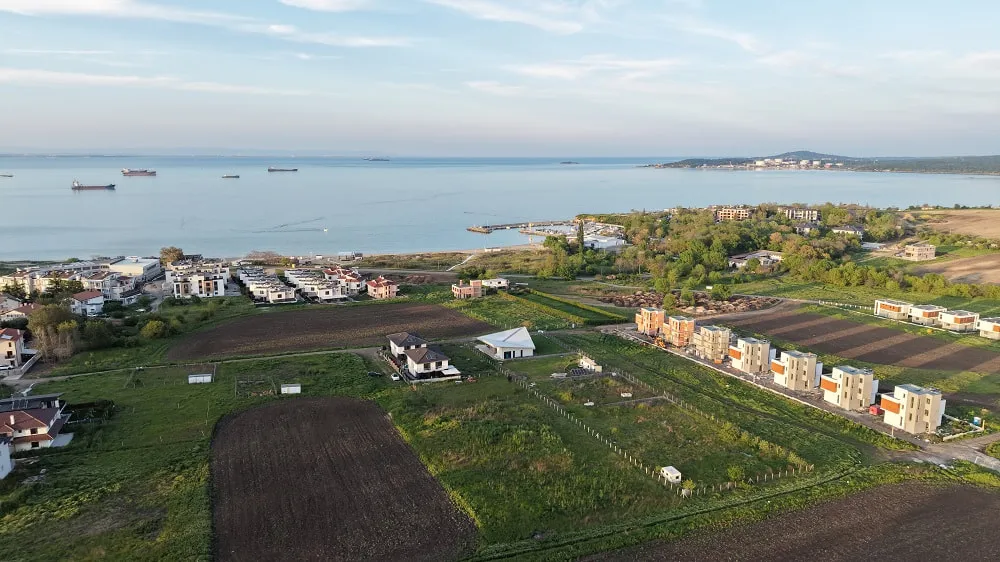
In Kraimorie, this investment strategy deserves particular attention. The area combines an excellent location close to Burgas, direct access to the Black Sea coast, predominantly low-rise residential development and a significant supply of well-positioned land. When investing in land, however, the purchase price is only one part of the equation. Far more important is what can actually be built on the property and under what conditions.
Why areland plots in Kraimorie attractive to investors?
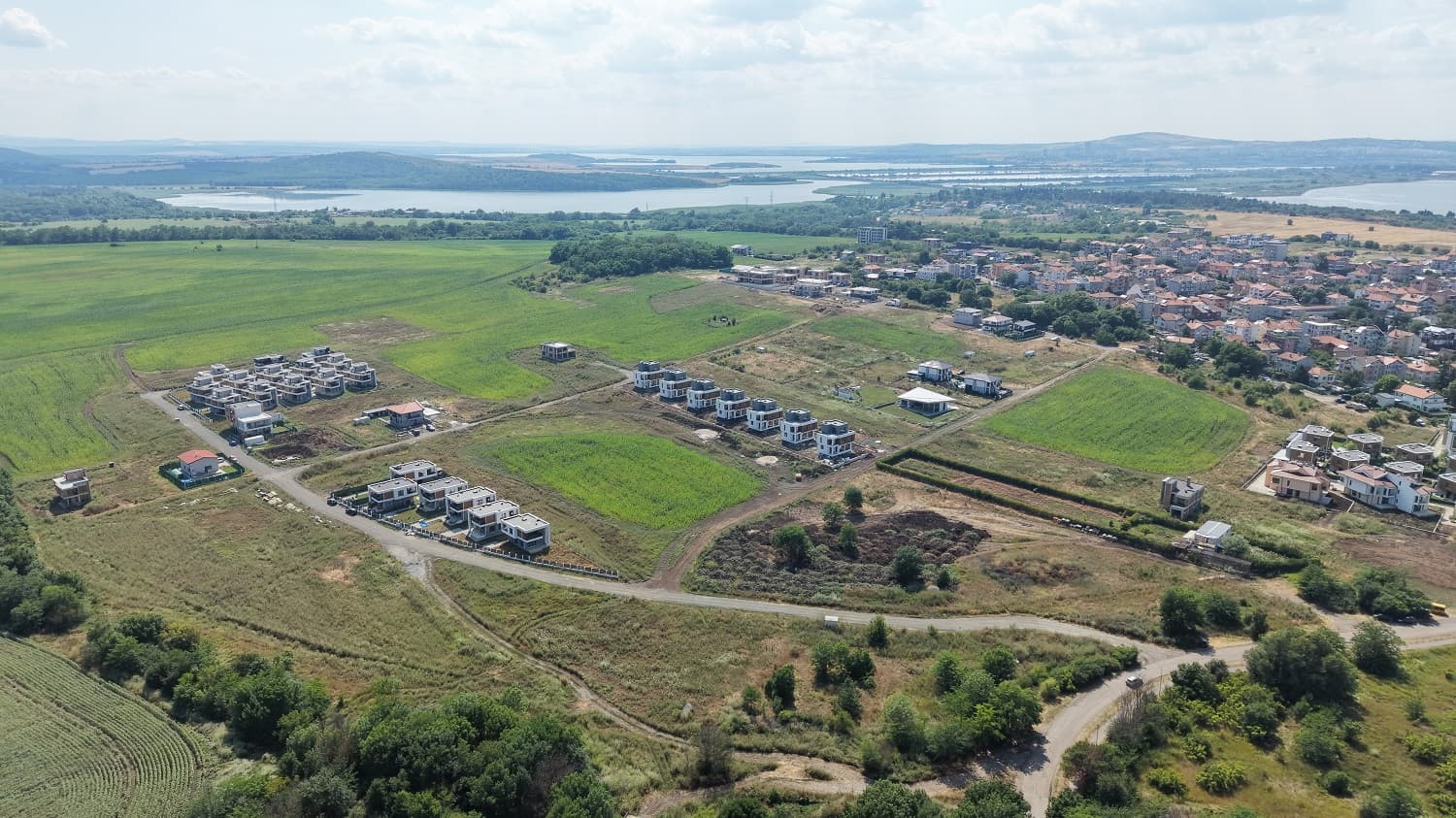
With most types of real estate, value is largely determined by what already exists: floor area, construction quality, location, views, floor level and condition. Land is different. A significant part of its value may come from what can potentially be developed on it in the future.
This is why land occupies a distinct position among the various investment strategies in Kraimorie. One plot may be suitable for building a private home, another for a small residential development, and a third for a complex of houses. Agricultural land on the outskirts may offer long-term potential if future urban development gradually expands towards it.
Kraimorie has another important characteristic. Although it is officially part of the city of Burgas, it has retained the character of a low-rise coastal residential area. This sets it apart both from conventional urban districts and from the seasonal resort towns along Bulgaria’s southern Black Sea coast.
Evidence of actual investment activity can also be found in the official planning procedures published by Burgas Municipality. In 2026, new Detailed Development Plan procedures for Kraimorie were published, together with investment proposals for new residential construction. This does not automatically indicate rising property prices, but it does demonstrate that residential development is continuing and that interest in new construction is more than theoretical.
Investors should nevertheless distinguish between the development of Kraimorie as a whole and the investment potential of an individual property. Even two neighbouring plots can have very different values if one has suitable land-use designation, access and development parameters, while the other is constrained by planning regulations, easements, infrastructure requirements or other development restrictions.
Regulated building plot or agricultural land – two very different investments
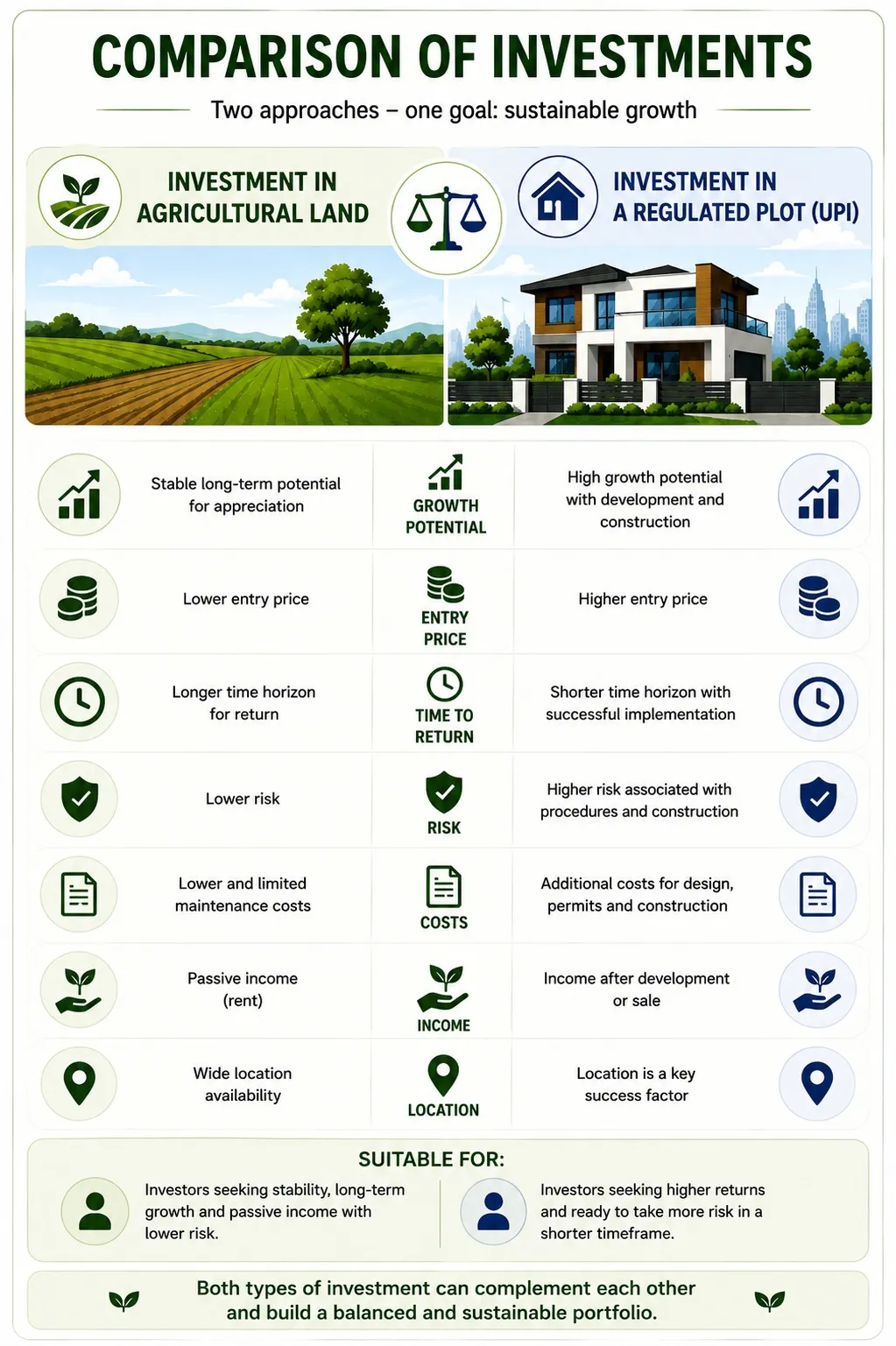
One of the first mistakes investors make when analysing land is comparing properties solely on their price per square metre.
At present, asking prices for land plots in Kraimorie can vary considerably, roughly from €50 to €200 per sq.m. The actual value depends on location, legal and planning status, permitted development parameters, access, existing infrastructure, plot size and shape, and proximity to the sea.
This wide range illustrates why an average price per square metre is not enough to determine whether a property represents a good investment.
A plot offered at €60–70 per sq.m may initially appear far more attractive than another priced at €150–180 per sq.m. However, if the cheaper property requires additional planning procedures, lacks infrastructure or has limited development potential, while the more expensive property is a well-positioned regulated building plot with clearly defined development parameters and the potential for relatively rapid project implementation, the higher-priced property may ultimately prove to be the better investment.
A regulated building plot — known in Bulgaria as an UPI (УПИ) — generally provides much greater clarity regarding permitted land use, planning status and development potential. This allows an investor to build a considerably more realistic financial model: how much gross floor area could potentially be developed, the approximate construction cost and the likely end value of the completed properties.
With agricultural land, much of this certainty may be absent. Its lower acquisition price is often compensation for the higher level of uncertainty.
A professional investment analysis should therefore not begin with the question: “How much does the land cost per square metre?”. It should begin with: “What can I realistically do with this property, and how much will it cost to unlock its development potential?”.
Regulated residential building plots – The most direct land investment model
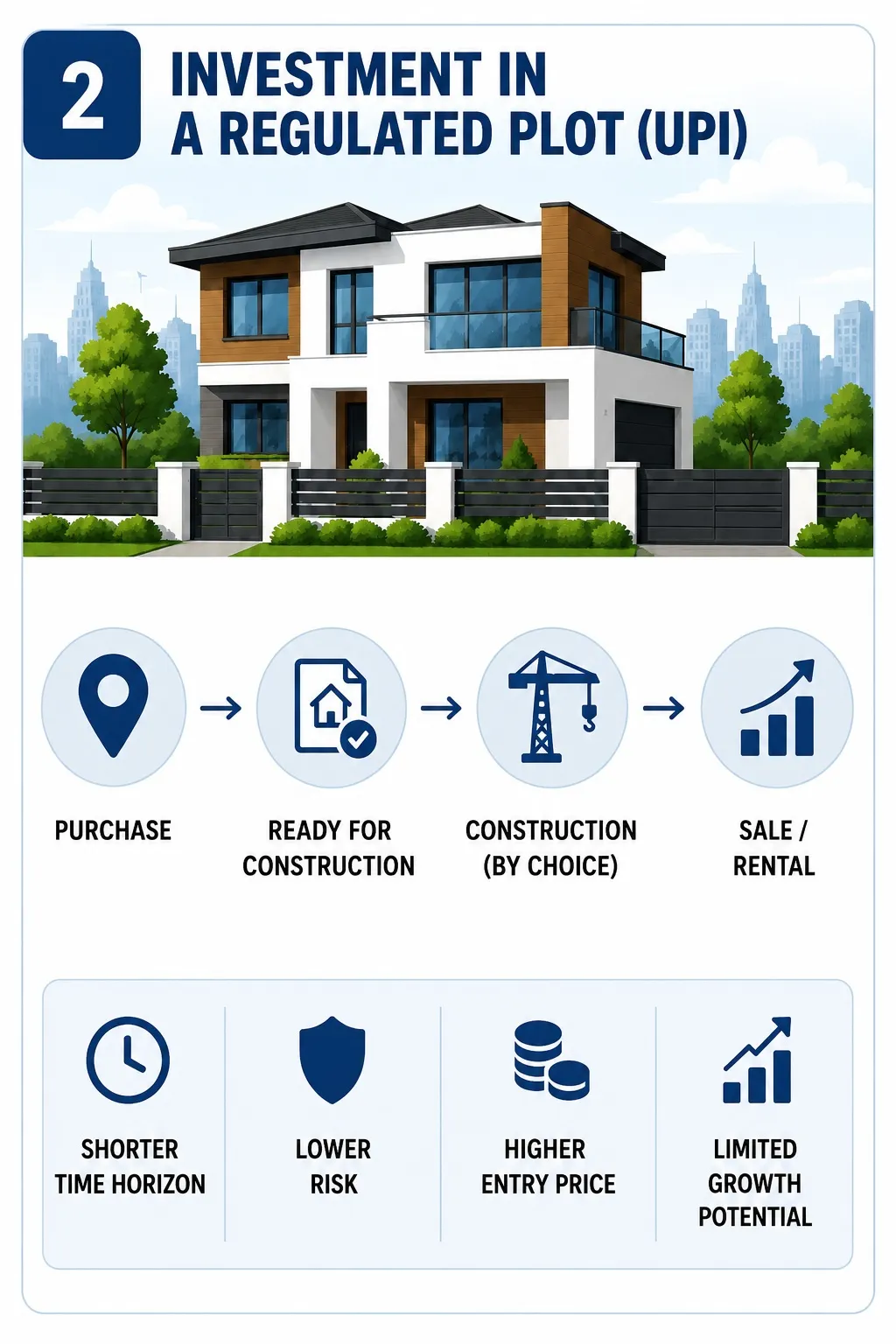
For investors looking for a more predictable development horizon, a regulated plot with an appropriate land-use designation usually offers the most direct route from land acquisition to project implementation.
However, regulation alone is not enough.
Before acquiring a property, investors should examine its designated use, the applicable Detailed Development Plan (PUP), planning zone, permitted building height, site coverage, Floor Area Ratio (FAR) — known in Bulgaria as KINT — minimum landscaped area, required building setbacks, street access, potential connections to water, sewerage and electricity networks, as well as any easements or other restrictions.
The reason is straightforward: an investor does not make money from the number of square metres of land purchased, but from the land’s economically viable development potential.
There are specific planning procedures in Kraimorie that illustrate this principle. In one procedure concerning a property within a low-rise residential zone (Жм), the specified development parameters include a maximum building height of 7 metres, site coverage of 20–25%, a KINT/FAR of up to 1.2 and a minimum landscaped area of 50%.
These parameters relate to that specific planning case and should not be assumed to apply automatically to every property in Kraimorie. They do, however, demonstrate how strongly planning parameters can influence the investment value of a plot.
Consider a 1,000 sq.m plot with permitted site coverage of 25%. The maximum building footprint would theoretically be approximately 250 sq.m. With a KINT/FAR of 1.2, the theoretical maximum gross floor area could reach 1,200 sq.m.
That does not automatically mean that an investor will be able to build and sell 1,200 sq.m of residential property.
Architectural design, setbacks, height restrictions, parking requirements, common areas, technical rooms, plot geometry and other regulatory requirements can significantly affect the amount of space that can actually be built and sold.
This is why experienced investors commission a detailed feasibility study with an architect before acquiring the land, rather than after completing the purchase.
Location within Kraimorie matters
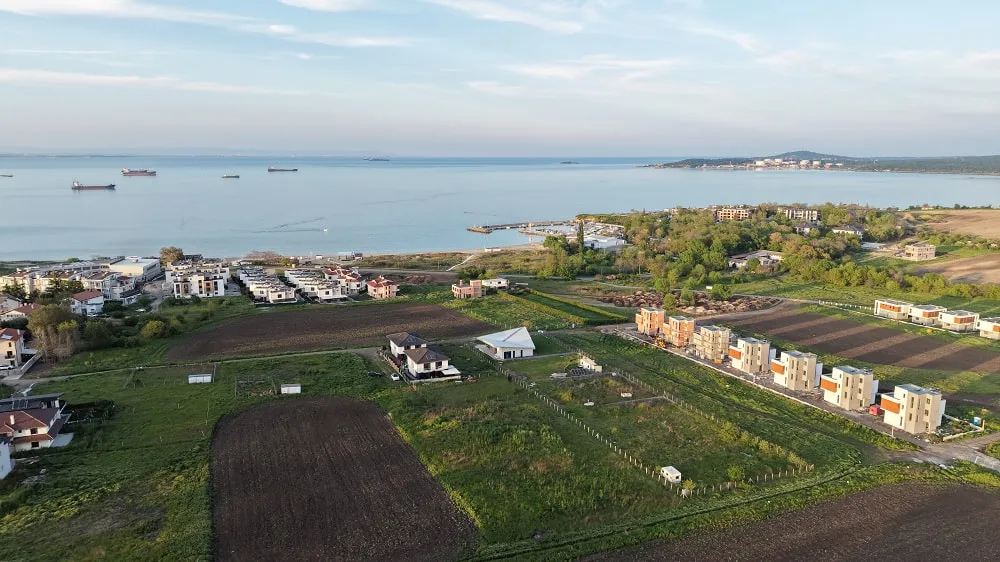
Simply describing a property as a “land plot in Kraimorie” is not sufficient for a meaningful investment assessment. Different parts of the neighbourhood and its surrounding territory have very different investment profiles.
Within the existing urbanised area, the most important factors tend to be permitted development parameters, infrastructure, road access, proximity to the sea and the character of the immediate surroundings.
In peripheral areas, the analysis becomes more complex. Larger properties and lower acquisition prices may be available, but investors need to consider the prospects for future urban expansion, the property’s proximity to already regulated and developed areas, road accessibility and the potential cost of constructing roads and connecting the property to electricity, water and sewerage infrastructure.
Plots close to the Burgas–Sozopol road and the main transport connections to Kraimorie also require careful assessment. Proximity to a major road can be an advantage, but it does not automatically make a property suitable for residential development. Investors must consider the land-use designation, access arrangements, easement zones, noise, infrastructure and the type of development envisaged for the area.
Properties close to the sea are also subject to restrictions under Bulgaria’s Black Sea Coast Development Act, including the specific rules applicable within Zones A and B, as well as relevant environmental legislation.
Sea views and proximity to the beach may contribute to higher future market value, but they should never replace a proper assessment of what can legally and practically be developed on the property.
For a private investor, a well-positioned plot may also make sense as a location for a villa on the Bulgarian Black Sea coast. A professional developer, however, must evaluate the same land primarily in terms of the potential revenue generated by the future project.
The proposed amendment to the Burgas General Development Plan and why it matters to investors
One of the most important factors currently affecting the long-term analysis of land around Kraimorie is the procedure to amend the General Development Plan of Burgas (OUP).
In June 2026, Burgas Municipality published a draft amendment to the General Development Plan, explicitly covering the city of Burgas together with Kraimorie, Sarafovo, Meden Rudnik, Dolno Ezerovo, Gorno Ezerovo, Lozovo, Rudnik and Cherno More, including their surrounding territories.
The procedure also includes environmental assessment documents, assessments of potential impacts on protected areas, and updated rules and regulations for implementing the General Development Plan.
For land investors, this is an important development because the General Development Plan establishes the long-term spatial framework for how the territory may develop.
There is, however, a crucial distinction.
The inclusion of land within an area designated for potential future development under the General Development Plan does not automatically convert agricultural land into a regulated building plot, nor does it automatically create development rights.
The General Development Plan (OUP) and the Detailed Development Plan (PUP) serve different purposes.
The prospect of future development in a particular area should therefore not, by itself, justify valuing agricultural land as if it were already a future building plot. Instead, it should be regarded as an initial positive indicator, after which the specific legal, planning, technical and financial path towards development must be investigated.
One potentially attractive strategy is to acquire land at a lower price before the development of the surrounding area and future building opportunities increase its value.
This strategy also carries considerably greater risk. Expected development may be delayed, planning priorities may change, or the individual property may ultimately fail to meet the requirements necessary for development.
Agricultural land around Kraimorie – Lower entry price, higher risk
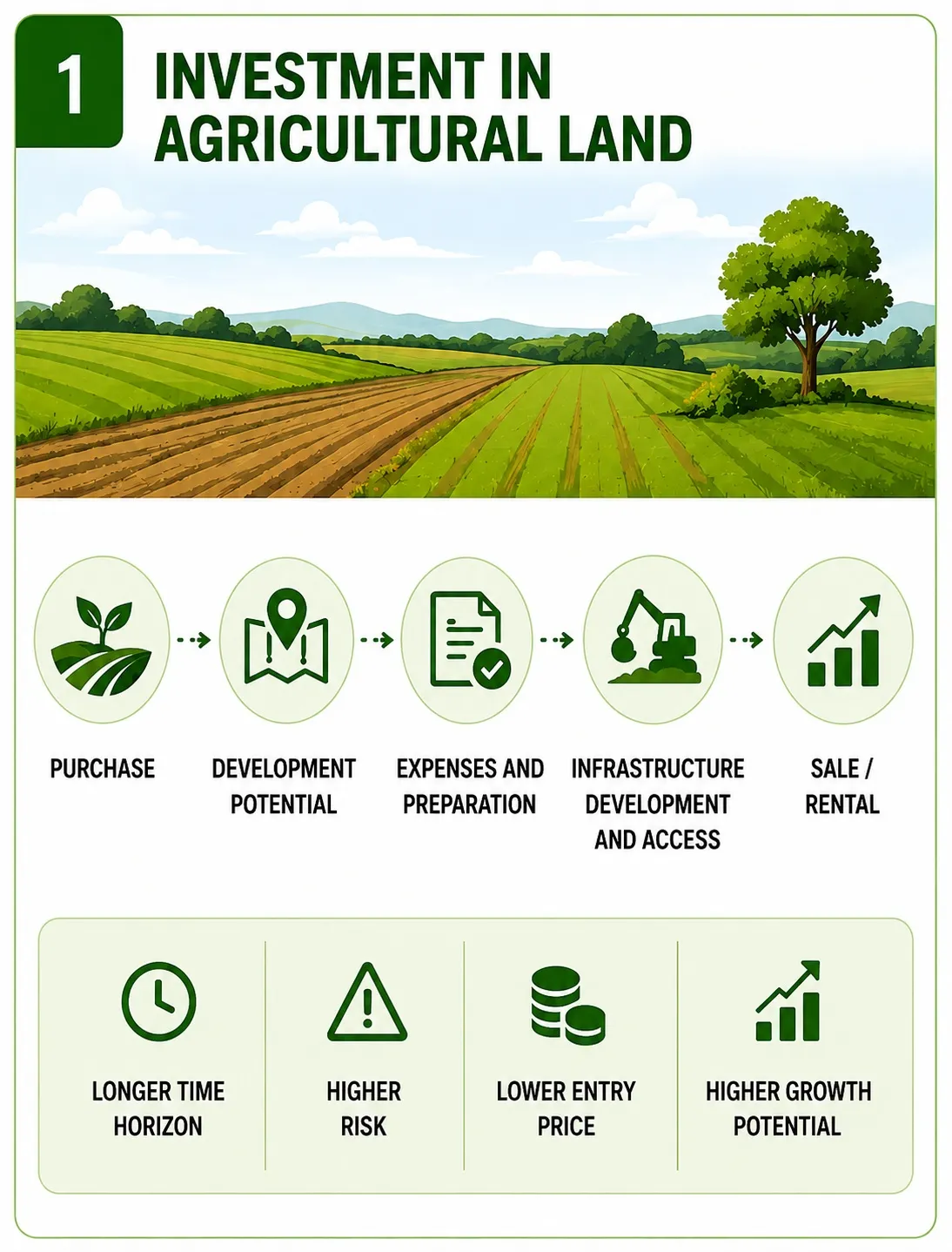
Buying agricultural land close to an expanding urban area is a classic long-term real estate investment strategy.
The basic logic appears straightforward:
purchase relatively inexpensive land → future urban development → change of land use and regulation → significant increase in property value
In practice, the middle stages of this process are precisely where the greatest uncertainty lies.
Not every piece of agricultural land close to Kraimorie will eventually become urbanised. Not every property located in a potentially attractive development corridor will receive the desired land-use designation. Even where the broader planning framework permits future development, the process may require considerable time and capital.
A professional investor therefore does not simply buy a “field next to the regulated area.” The key question is how likely that land is to become economically viable for the investor’s intended development strategy.
Larger properties immediately adjacent to existing regulated and developed areas can be particularly interesting. Existing road access and realistic opportunities to connect to electricity, water and sewerage networks are further advantages.
The more of these conditions are missing, the more speculative the investment becomes.
It is important to distinguish between speculative and bad investment. They are not necessarily the same thing.
An investor may deliberately accept greater planning risk in exchange for the possibility of significantly higher capital appreciation. The problem arises when that additional risk is not reflected in the acquisition price.
Example land investment scenario
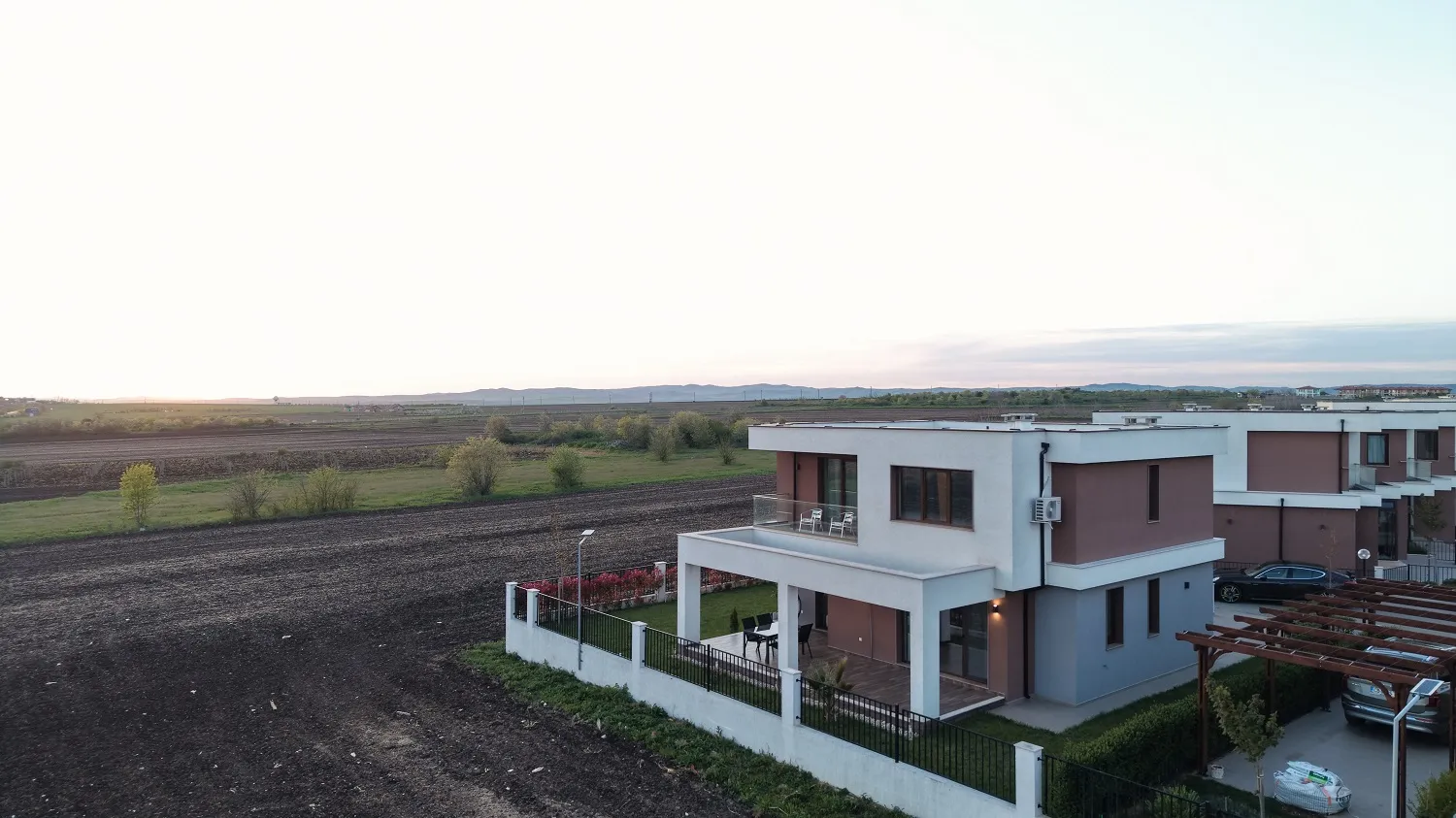
Consider a hypothetical 5,000 sq.m property in a potentially attractive development area of Kraimorie, available for €50 per sq.m.
Acquisition price: €250,000
We are deliberately using the lower end of the indicative price range because this strategy assumes the acquisition of a larger property that still requires additional planning and investment before its full potential can be realised.
A well-positioned and fully regulated building plot may command a significantly higher price — potentially €150–200 per sq.m — which would fundamentally change the economics of the project.
The initial €250,000 acquisition price is only the starting point. The investor must also account for transaction costs, planning and technical studies, design work, administrative procedures, a potential change of land use, necessary infrastructure and the cost of securing proper road access.
For the purposes of this example, assume that after all procedures and required investment, the total capital invested reaches approximately:
€350,000
However, the entire original 5,000 sq.m may not remain saleable. Part of the land may need to be allocated for roads, access, technical infrastructure or other planning requirements.
If, after subdivision, the investor is left with 4,000 sq.m of net saleable land, the effective cost becomes:
€350,000 ÷ 4,000 sq.m = €87.50 per sq.m of saleable land
This is where the actual investment analysis begins.
If the newly created individual plots can subsequently be sold at an average price of €140 per sq.m, potential revenue would be:
4,000 sq.m × €140 = €560,000
The difference between €560,000 in revenue and €350,000 in invested capital is:
€210,000
This figure is before taxation, financing costs, sales expenses and other associated costs.
It represents an approximate 60% gross return on invested capital over the entire project period.
However, if the planning and development process takes several years, the annualised return will be substantially lower. This is why time itself should be treated as a genuine investment cost.
The scenario also illustrates the downside risk.
If the eventual market price reaches only €100 per sq.m rather than the expected €140, total revenue would fall to:
4,000 sq.m × €100 = €400,000
The expected profit would then decline to approximately €50,000, even before the remaining transaction, financing, taxation and sales costs are taken into account.
This is precisely why the acquisition price of land has such a significant impact on the future return.
If an investor pays a high price for a property before establishing exactly what can be built, under what conditions and at what additional cost, the investment risk increases substantially. Infrastructure, road access and administrative procedures can significantly reduce the expected profit.
These calculations are illustrative and are intended to demonstrate how a potential financial scenario might be structured.
Current asking prices for land plots in Kraimorie can vary widely, approximately between €50 and €200 per sq.m. The actual value of an individual property depends on its location, planning and legal status, development potential, infrastructure access and numerous other site-specific characteristics.
For this reason, a low price per square metre does not necessarily represent a good investment. What matters is the additional cost required for planning and regulation, road access, infrastructure, and preparing the property for future development or resale.