



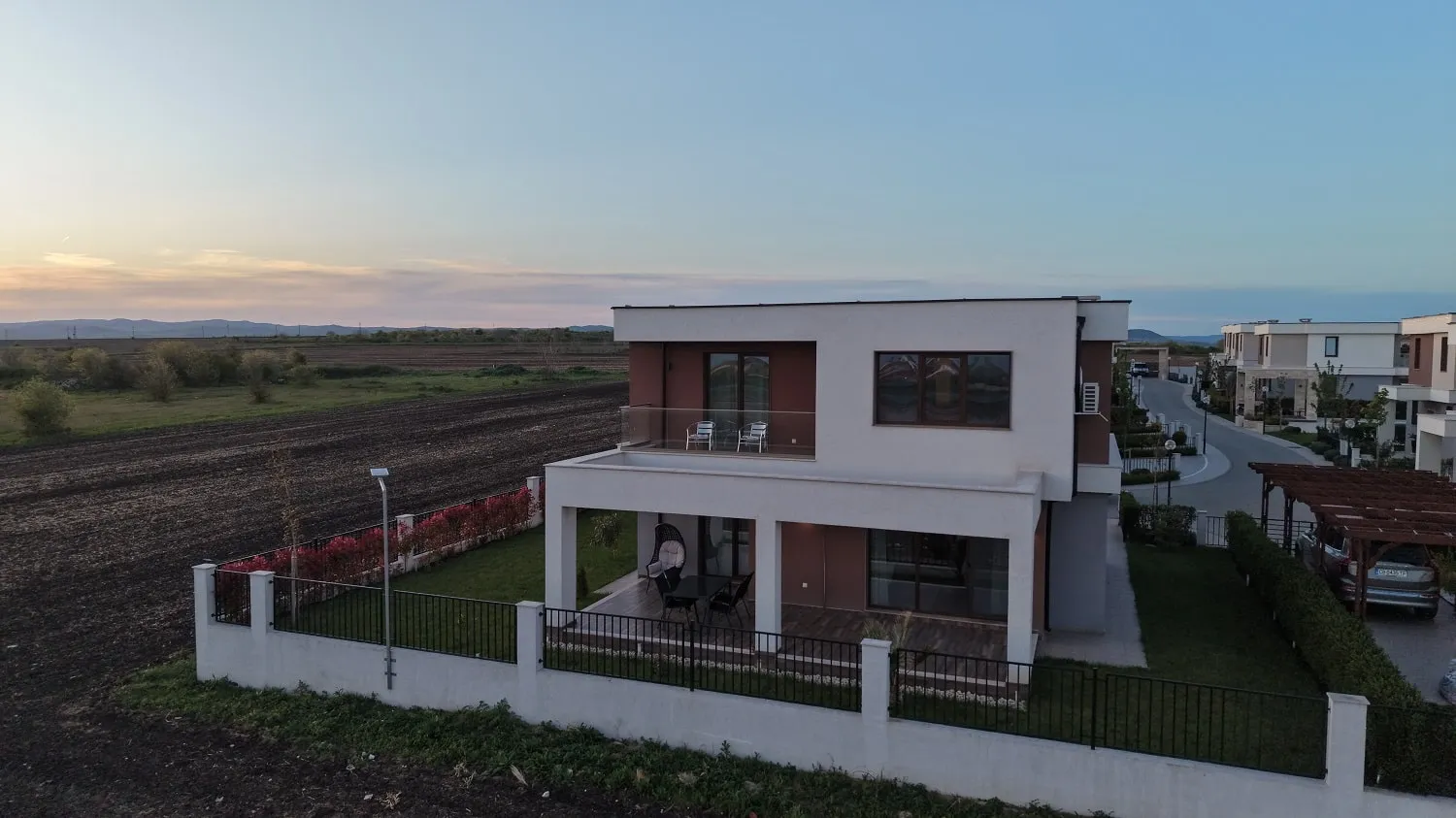

Kraimorie is gradually establishing itself as an increasingly attractive area for residential property investment close to Burgas. Its combination of a seaside location, beaches, relatively low-density development and quick access to the city means that property here should not be viewed exclusively as holiday real estate. Depending on the property, it can also serve as a year-round home, a rental asset or a longer-term investment for future resale.
When assessing property investment in Kraimorie, however, the price per square metre should never be considered in isolation. The initial purchase price, location, time before the property begins generating income, construction quality, liquidity and potential for future appreciation are all part of the same investment equation.
What is the investment profile of residential property in Kraimorie?
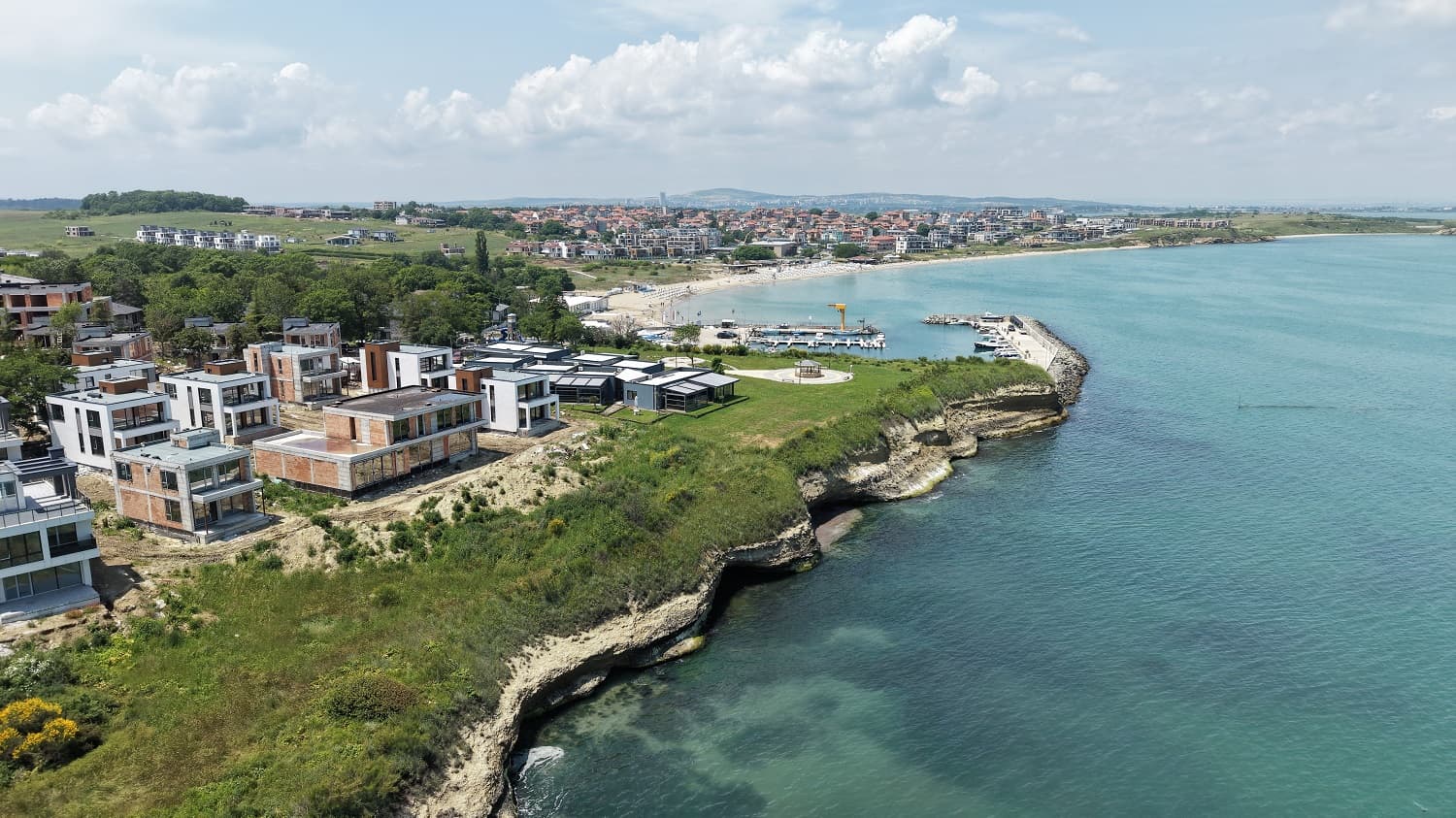
One of Kraimorie’s main advantages is that the same property can appeal to several different groups of buyers. An apartment close to the sea, for example, may be purchased as a holiday home and also rented out during the summer season. At the same time, the same property may appeal to someone working in Burgas who prefers to live permanently in a quieter coastal environment rather than in one of the city’s more densely built-up districts.
From an investment perspective, this versatility is important. The more realistic uses a property has, the less dependent its owner is on a single type of demand. A home that can work equally well for personal use, holiday letting, long-term renting or eventual resale usually offers a more flexible investment profile.
There can nevertheless be substantial differences between individual properties within Kraimorie itself. In coastal markets, even a few hundred metres can significantly affect investment value. A property with a genuine sea view, convenient walking access to the beach, secure parking and good road access should not automatically be compared with a similarly sized apartment further inland simply on the basis of price per square metre.
The same applies to new developments. Two projects may offer similar launch prices but have completely different investment potential because of construction quality, apartment layouts, parking, infrastructure, stage of completion and the possibility of future development around them. The more useful question is therefore not simply, “How much does the property cost per square metre?” but rather, “What am I actually receiving for that price, and how easy will this asset be to rent or sell five or ten years from now?”
Buying an off-plan apartment: Where does the potential profit come from?

Buying an off-plan property is one of the most common investment strategies in a developing residential market. The basic principle is straightforward: the investor enters a project at an early stage, when the price is usually lower, and expects the value of the property to increase as construction progresses and the number of available units decreases.
If the development performs well, there are generally two main strategies. The first is to resell the property at a later stage of construction or after completion and realise a capital gain. The second is to retain the property as a longer-term asset and generate rental income once the building is completed.
The advantage of a lower entry price
The main attraction of buying off-plan is the possibility of securing a lower initial price than that of a comparable completed property. The actual difference depends on the project, the stage of construction and broader market conditions. In some developments the discount may be modest, while in others early buyers may receive significantly better terms.
Staged payment plans can provide another advantage. Instead of paying the entire amount at the beginning, the buyer may be able to make payments linked to construction milestones. This can give the investor more flexibility in managing available capital.
However, one of the most common mistakes is to assume that because an off-plan apartment is cheaper, it is automatically the more profitable investment. That is not always the case.
The cost of time: A factor investors often overlook
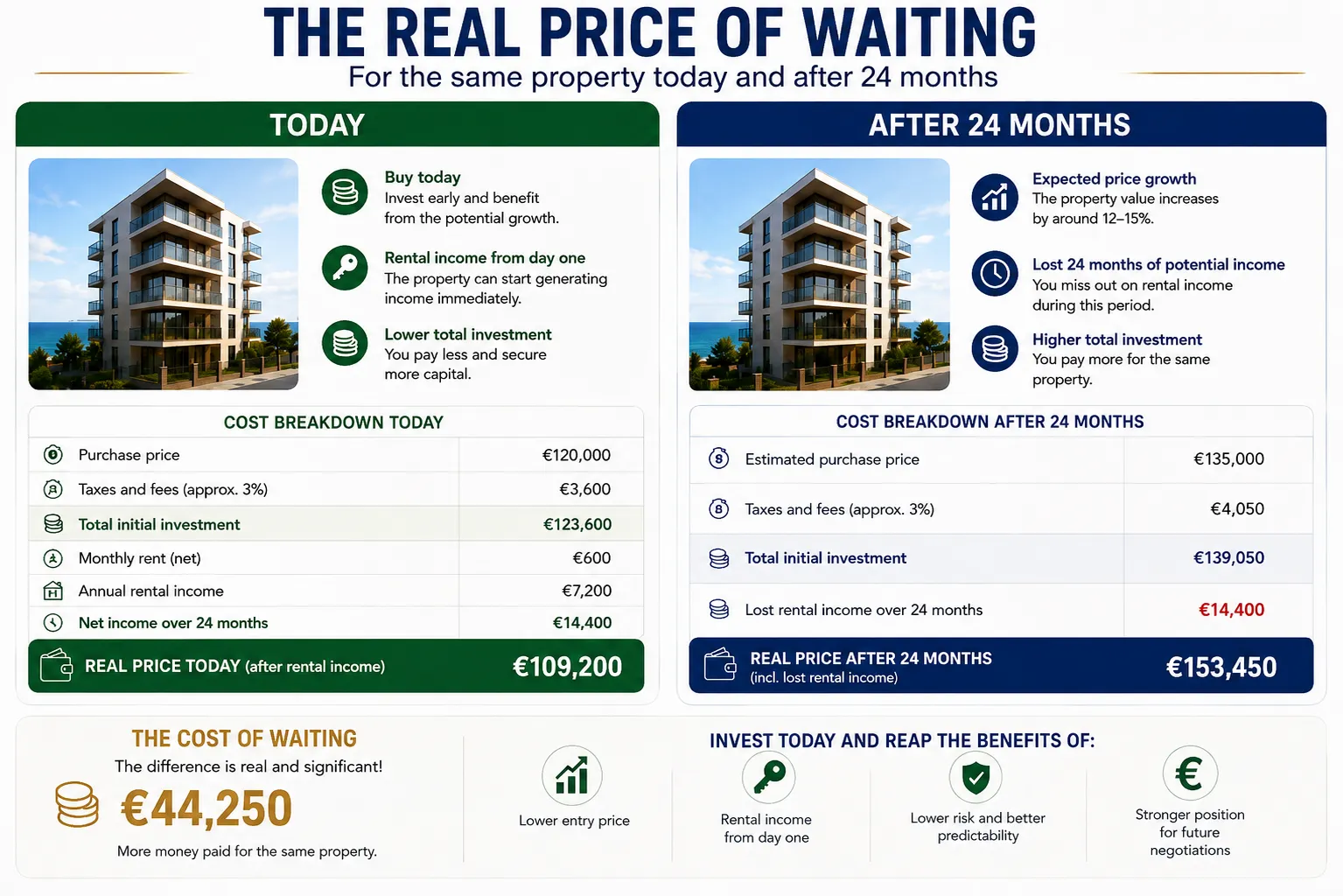
Time has a financial value. If an apartment is purchased at an early stage of construction and completion is still two or three years away, the property normally cannot generate rental income during that period.
A completed apartment is different. Once purchased, furnished and prepared for occupation, it can potentially enter the rental market relatively quickly. The correct comparison is therefore not simply the price of an off-plan apartment versus the price of a completed one. The investor should also consider the time to completion, lost rental income, additional risk and the way in which capital is committed.
Consider a simplified example. If a comparable off-plan apartment is offered for €120,000 while a completed property costs €135,000, the initial difference is €15,000, or approximately 11% of the completed property’s value. At first glance, the off-plan purchase appears considerably more attractive.
However, if construction takes another two years, the completed apartment could generate rental income during that period. With an indicative net annual return after operating costs of around €5,000–€7,000, two years could represent approximately €10,000–€14,000 in potential income. In that case, much of the initial price difference may effectively disappear.
This does not automatically make the completed apartment the better investment. The off-plan property may appreciate during construction, and a staged payment plan may mean that the buyer has not committed the full amount from day one. The key point is that the discount on an off-plan property should be sufficient to compensate for time, risk and the opportunity cost of delayed income.
Appreciation during construction is not guaranteed profit
A common argument in new-build markets is that an apartment purchased at an early stage will inevitably be worth more by the time the building is completed. In a rising market, this is certainly possible and is one of the main reasons investors buy early. However, future appreciation should never be treated as guaranteed.
The property’s value two or three years later will depend on a wide range of factors, including the general state of the residential market, mortgage availability, financing costs, buyer incomes, the volume of new supply in the area, the quality of the specific development and the prices of competing properties.
A more professional approach is to analyse the investment under several scenarios. In a favourable market, an early purchase may generate strong capital appreciation. Under a more moderate scenario, the main advantage may simply remain the lower entry price. If prices remain relatively flat, the property should ideally still make sense because of its quality, location and ability to generate rental income.
The better an investment performs under conservative assumptions, the less dependent it is on the speculative expectation that property prices will always continue rising.
What are the risks of buying off-plan?
The lower initial price of an off-plan property partly compensates the buyer for the additional risk taken before the building is completed. The most obvious risk is construction delay. A project expected to take two years may require longer because of administrative procedures, financing issues, contractor problems, supply delays, design changes or other unforeseen circumstances.
For an investor, a serious delay has a direct economic effect. It postpones the moment when the property can be used or rented out, while financing costs may continue to accumulate if borrowed capital is involved.
There is also a risk that the final environment will be different from what the buyer expected when making the purchase. This is particularly relevant in developing areas. An apartment may have an excellent sea view at the time it is bought off-plan, but if there is an undeveloped plot in front of it with future building potential, that view may not be protected. The investor should therefore assess not only the building being purchased but also the planning status and development potential of neighbouring land.
What should be checked before buying an off-plan property?
Buying new construction should not begin with choosing the floor, orientation or apartment number. The first step should be to assess the project itself and the developer behind it.
Important issues include ownership of the land, development rights, the building permit, contractual arrangements with the developer, possible encumbrances affecting the land or property, completion deadlines, penalties for delays and the conditions under which individual payments are made.
The developer’s track record is equally important. Completed previous projects often reveal far more than architectural visualisations. They show how façades perform after several years, how common areas were finished, how well the buildings are maintained and whether the final result matched what was originally promised.
Construction quality is even more important for coastal property. Higher humidity and salty sea air place greater demands on façade systems, metal components, windows, waterproofing and the building’s overall protection. A low purchase price can quickly become irrelevant if the property or building requires expensive repairs and maintenance only a few years later.
Completed apartments: A higher price in exchange for greater certainty
With a completed property, the investor will normally pay more, but in return receives something extremely valuable: considerably more information and predictability. Instead of relying on architectural visualisations, the buyer can inspect the real building and assess the common areas, façade, lift, actual sea view, noise levels, access, parking and surrounding infrastructure. It is also possible to determine how the building is managed, what the real maintenance costs are and whether apartments are occupied mainly during the summer or throughout the year. Most importantly from an investment perspective, the buyer can assess actual demand today rather than trying to predict what the market might look like two or three years from now. That lower level of uncertainty has economic value, and it is one of the reasons completed properties usually command a higher price.
Completed or off-plan: Which is the better investment?
There is no universal answer. When a project has a reliable developer, a strong location, a reasonable entry price and a sufficiently large discount compared with completed properties, buying at an early stage can offer excellent potential for capital appreciation.
However, when the price difference between an off-plan and a completed property is relatively small, the investment logic begins to change. A completed apartment can potentially start generating income immediately, there is no construction-delay risk and the investor can evaluate the property’s real quality, surroundings and current market demand.
The correct comparison is therefore not only how much each property costs today. It is more useful to compare where the investor is likely to stand financially by the time the off-plan apartment has been completed and is ready to use.
If the completed apartment has generated substantial rental income during that period, its initially higher purchase price may prove economically justified. If, on the other hand, the off-plan property was acquired at a significantly better price and appreciated sufficiently during construction, the early purchase may prove more profitable. The real answer comes from comparing price, time, income and risk together.
A completed apartment as an income-producing asset
For a completed investment property, rental strategy should ideally be considered before the purchase itself. The investor needs to decide which model makes the most economic sense: short-term holiday rentals, long-term residential letting, a hybrid approach or personal use combined with occasional rental.
Kraimorie is particularly interesting because it combines characteristics of both a coastal destination and an urban residential location. During the summer, proximity to the beach creates conditions for tourist demand, while the short distance to Burgas can make the same property attractive to people seeking longer-term accommodation.
This dual function can be one of the strongest advantages of a carefully selected residential property in Kraimorie. At the same time, potential income should never be confused with profit. The advertised nightly rate or monthly rent does not show the actual return unless occupancy, seasonality, management, maintenance, furnishing, taxes, fees and vacancy periods are also taken into account.
Short-term rentals: strong potential, but seasonality matters
Short-term letting is a natural strategy for a property in a seaside district. In Kraimorie, the summer months can support higher nightly rates and stronger occupancy, particularly for apartments that combine a good location, sea view, proximity to the beach and convenient parking.
However, this does not mean that every apartment in Kraimorie is automatically suitable for this model. In the short-term rental market, micro-location, furnishing quality, functionality, terrace space, views, air conditioning, parking and the overall guest experience can have a major effect on performance.
The difference between a property that genuinely offers easy walking access to the beach and one that is simply located within Kraimorie is especially important. For tourists, that difference has real value and can influence both booking demand and achievable rates.
Rental revenue is not the same as profit
One of the most common mistakes in short-term rental analysis is to multiply the advertised nightly price by the number of days in the summer season. That almost always produces unrealistic expectations. A proper calculation should include vacant nights, booking-platform commissions, cleaning, laundry, consumables, property management, minor repairs, replacement of furniture and equipment, and the faster wear associated with frequent guest turnover. If the property is managed by an external company, its management fee should also be included. An apartment that appears capable of generating €12,000–€15,000 in annual gross revenue may therefore produce a much lower net return once all costs are deducted. For an investor, net yield is far more important than turnover.
How should real rental yield be calculated?
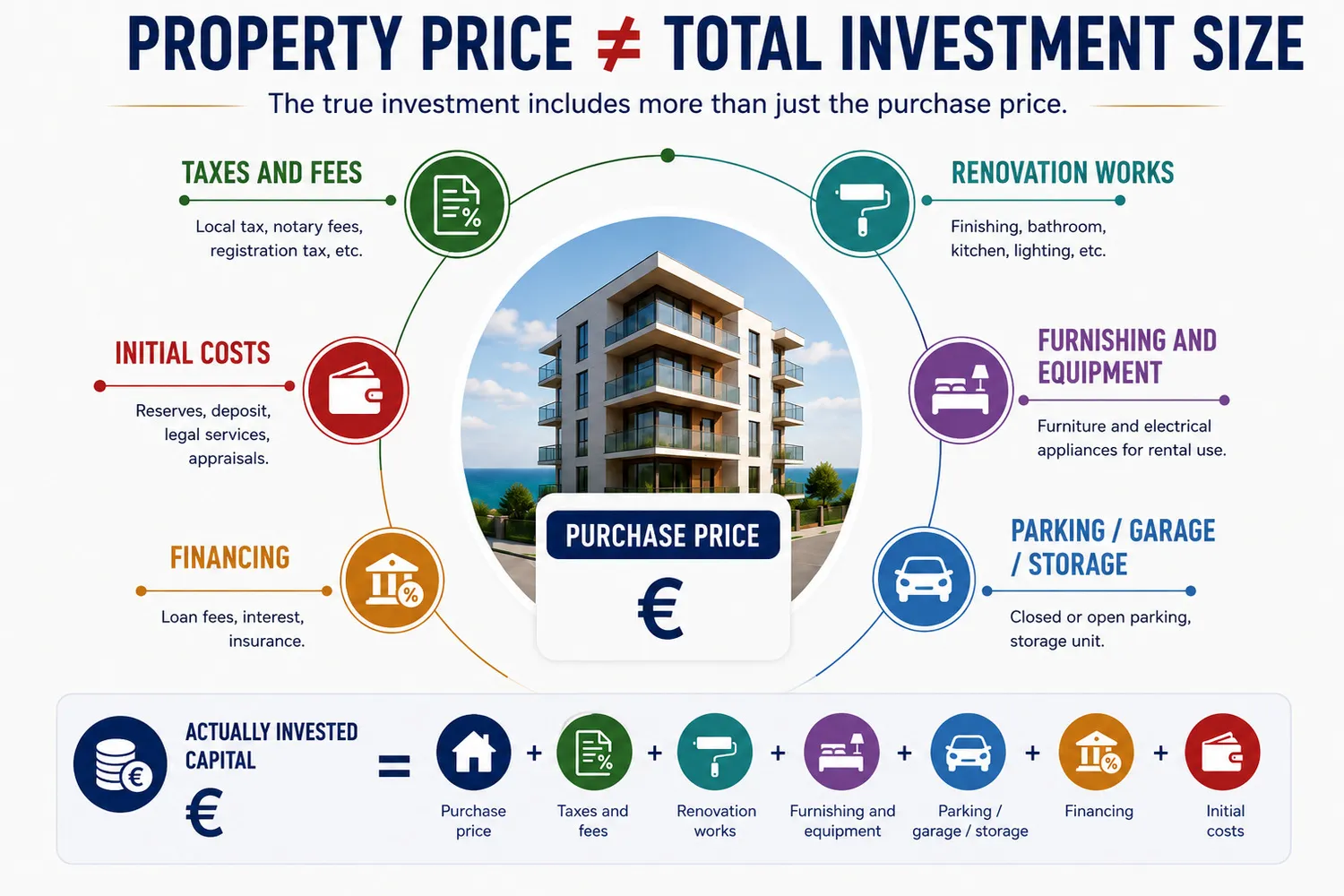
At its simplest, rental yield should be calculated by comparing annual net income with the total capital invested. The purchase price is only one part of that capital.
The investor may also need to include notarial and local transaction costs, agency commission where applicable, finishing works, furniture, appliances, parking, financing expenses and the initial preparation of the property for rental.
If, for example, an apartment is purchased for €130,000 but the total investment reaches €145,000 after furnishing, fees and other expenses, the return should be calculated on €145,000 rather than on the purchase price alone. The same principle applies to income. If annual gross revenue is €10,000 but only €7,000 remains after operating costs, it is the €7,000 figure that should be used when assessing the actual return.
Long-term rentals
Long-term letting has a different investment profile. The objective is usually not to maximise the amount earned per occupied day, but rather to create a more stable cash flow with less operational involvement. This is where Kraimorie has a major advantage: its proximity to Burgas. The district can therefore be considered not only as a seasonal tourism location but also as a place for year-round living.
Potential tenants may include professionals working in Burgas, families seeking a quieter environment and people who want to live close to the sea without giving up access to a larger city. For these tenants, the most important characteristics are often slightly different from those valued by holidaymakers.
A sea view remains an advantage, but parking, practical layouts, efficient heating and cooling, quality windows, reasonable maintenance costs and convenient everyday access may become more important. For a year-round tenant, functionality usually carries more weight than a purely holiday-oriented atmosphere.
Short-term or long-term rental?
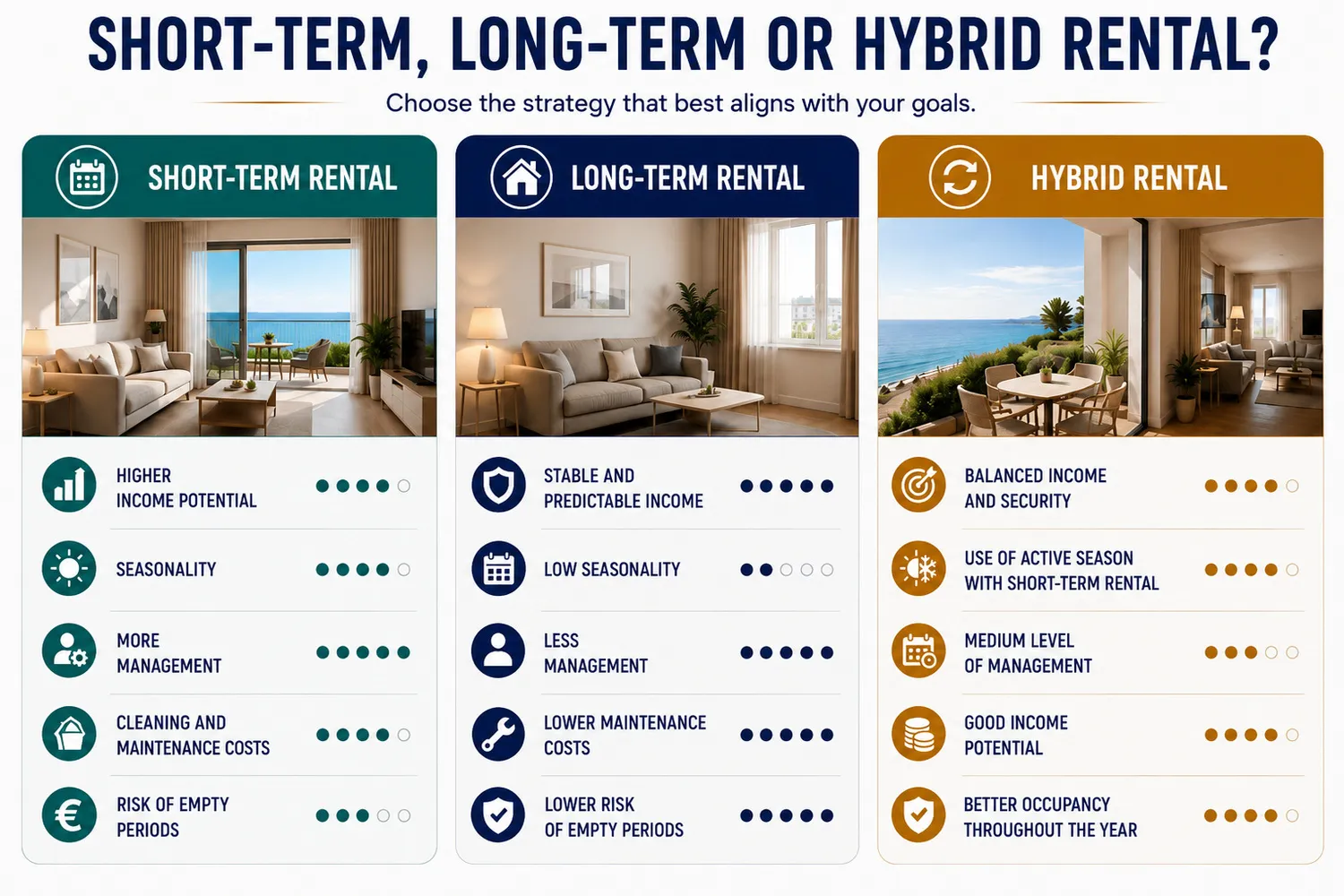
Neither model is universally better. Short-term renting has the potential to produce higher income per occupied day, but it requires more active management and is much more exposed to seasonality.
Long-term renting usually generates lower monthly income than a very strong summer season could produce, but it provides greater predictability, fewer turnovers and lower operating costs. The right choice therefore depends on the investor’s priorities.
If the objective is to maximise revenue and the owner is willing to manage the property actively, the short-term model may be suitable. If the priorities are stability, lower involvement and more consistent cash flow, long-term letting may be the better option.
A hybrid rental strategy
In theory, one of the most interesting strategies for Kraimorie is to combine short-term and longer-term rentals. A property could be rented to holidaymakers during the strongest summer months and used for medium-term or longer-term tenants during the rest of the year.
This allows the owner to benefit from higher seasonal rates without leaving the property completely unused in winter. In practice, however, such a strategy is more complicated than it first appears.
A conventional long-term tenant generally expects security and is unlikely to accept having to leave the property in May or June so that it can be rented to tourists. A more realistic approach may therefore involve medium-term rentals of several months, temporary accommodation for employees or other arrangements where the rental period is clearly defined from the beginning.
The hybrid model can be highly effective, but only when the property is managed carefully and the owner has realistic expectations about occupancy throughout the year.
Investing in townhouses
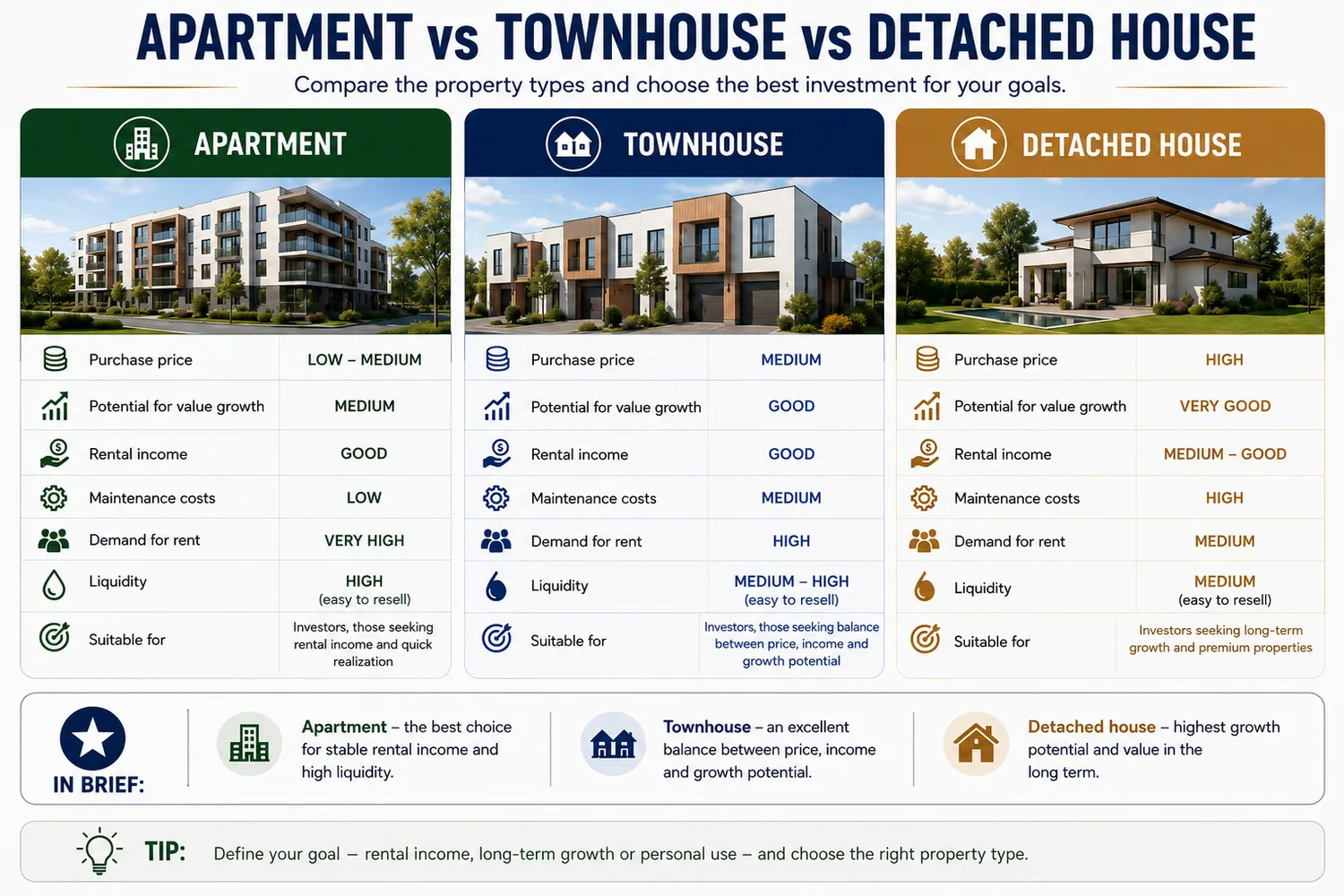
Townhouses occupy an interesting position between apartments and detached houses. They provide more space, a private garden or outdoor area and a stronger sense of having an individual home, while using land much more efficiently than fully detached properties. From an investment perspective, this can help developers and investors reach a broader group of buyers.
For a family that wants a garden and additional space but does not have the budget for a detached house on a large plot, a townhouse may be a very logical solution. This is why townhouses often sit between premium apartments and fully detached houses in terms of pricing. They offer some of the advantages of a house while remaining financially accessible to a larger market.
Why are townhouses interesting for investors?
One of their main advantages is the lower land cost allocated to each dwelling. When several homes are developed within a common plot, infrastructure, access and certain construction costs can be shared or optimised.
This can allow for a more competitive final price and therefore a wider pool of potential buyers. From a resale perspective, that broader market may also create better liquidity than a significantly more expensive detached property.
The trade-off is reduced privacy. Shared walls, smaller gardens and closer neighbours make townhouses less suitable for the very highest luxury segment. They should therefore not be seen as an inferior version of a detached house, but rather as a different investment product designed for a different buyer profile.
Detached houses and villas: limited supply and a higher market segment
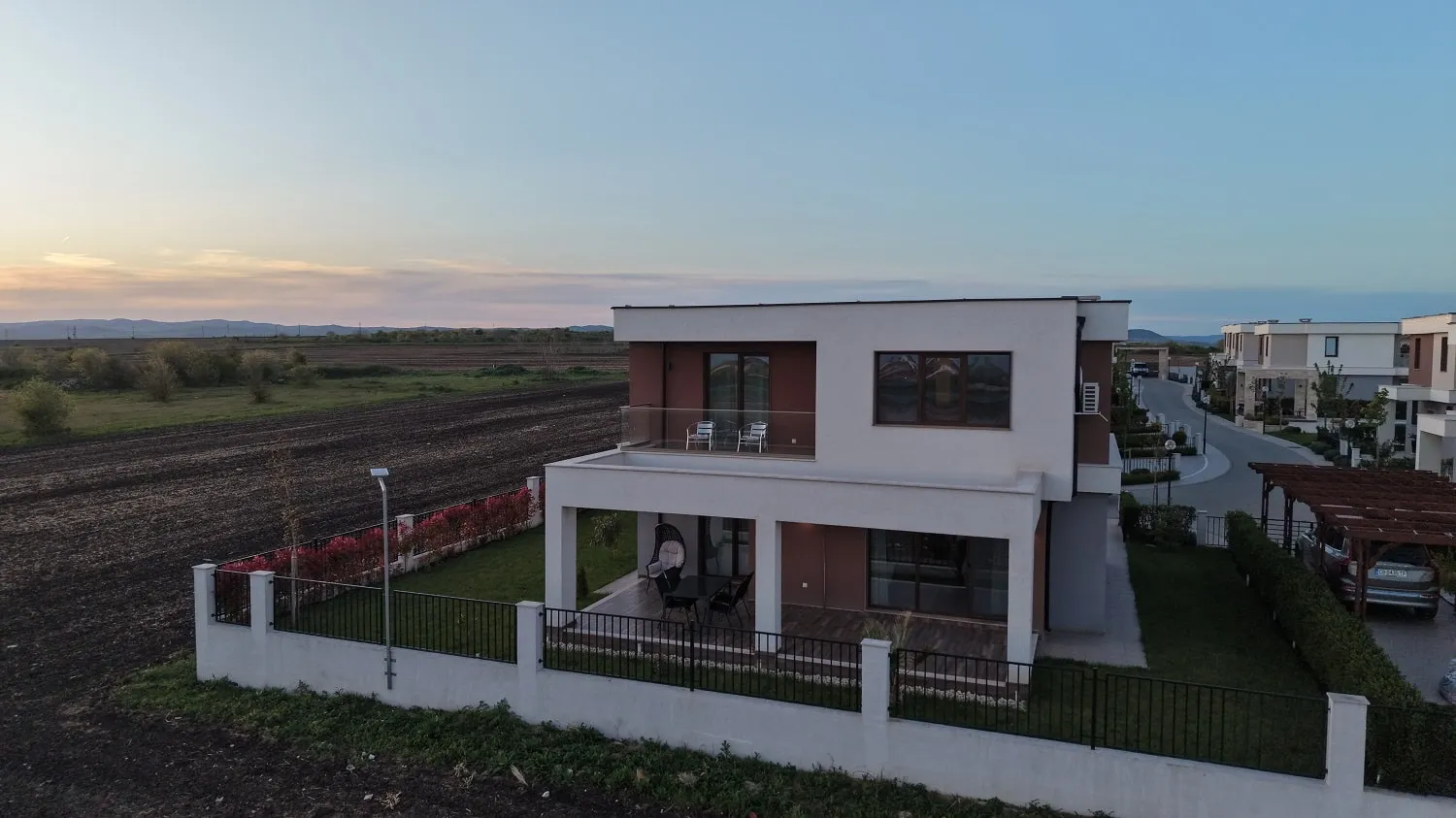
A detached house offers something that an apartment or townhouse cannot fully replicate: genuine private space. An individual plot, private garden, separate entrance, parking, the possibility of a swimming pool and greater distance from neighbouring properties all have significant value for a certain type of buyer. This becomes particularly important in coastal locations.
For someone looking for a villa on the Bulgarian Black Sea coast, proximity to the sea is only one part of the decision. Privacy, plot size, views, architecture, access, construction quality and the ability to use the property throughout the year can be equally important. This is precisely where detached houses can reach a significantly higher market segment than townhouses.
Why can detached houses retain their value better?
One reason is limited supply. A single residential building can contain many apartments, whereas high-quality detached houses with suitable plots, good locations and a genuine coastal setting are much harder to reproduce.
Land therefore plays a much more important role in the overall value of a detached house. As suitable plots become scarcer, ownership of an individual piece of land in a strong location can become increasingly valuable.
This does not mean that every house is a good investment. An oversized property designed without a clear target buyer may be much harder to sell than a well-planned house with functional living space, a sensible garden and good energy efficiency.
For this type of property, the quality of the concept matters greatly. The goal should not be to maximise built area at any cost, but to create a home that matches the needs and purchasing power of a clearly defined market.
Townhouse or detached house: which should an investor choose?
The answer depends largely on the target customer. If the objective is to reach a broader market and maintain a more accessible final price, townhouses may offer better liquidity.
If the investment is aimed at a higher-value segment, a detached house offers greater potential for differentiation. In this case, the buyer is not paying only for the square metres inside the building. They are also paying for the land, privacy, architecture, views and lifestyle associated with the property. This is why two houses with very similar built areas can have substantially different market values.
What increases the value of residential property in Kraimorie?
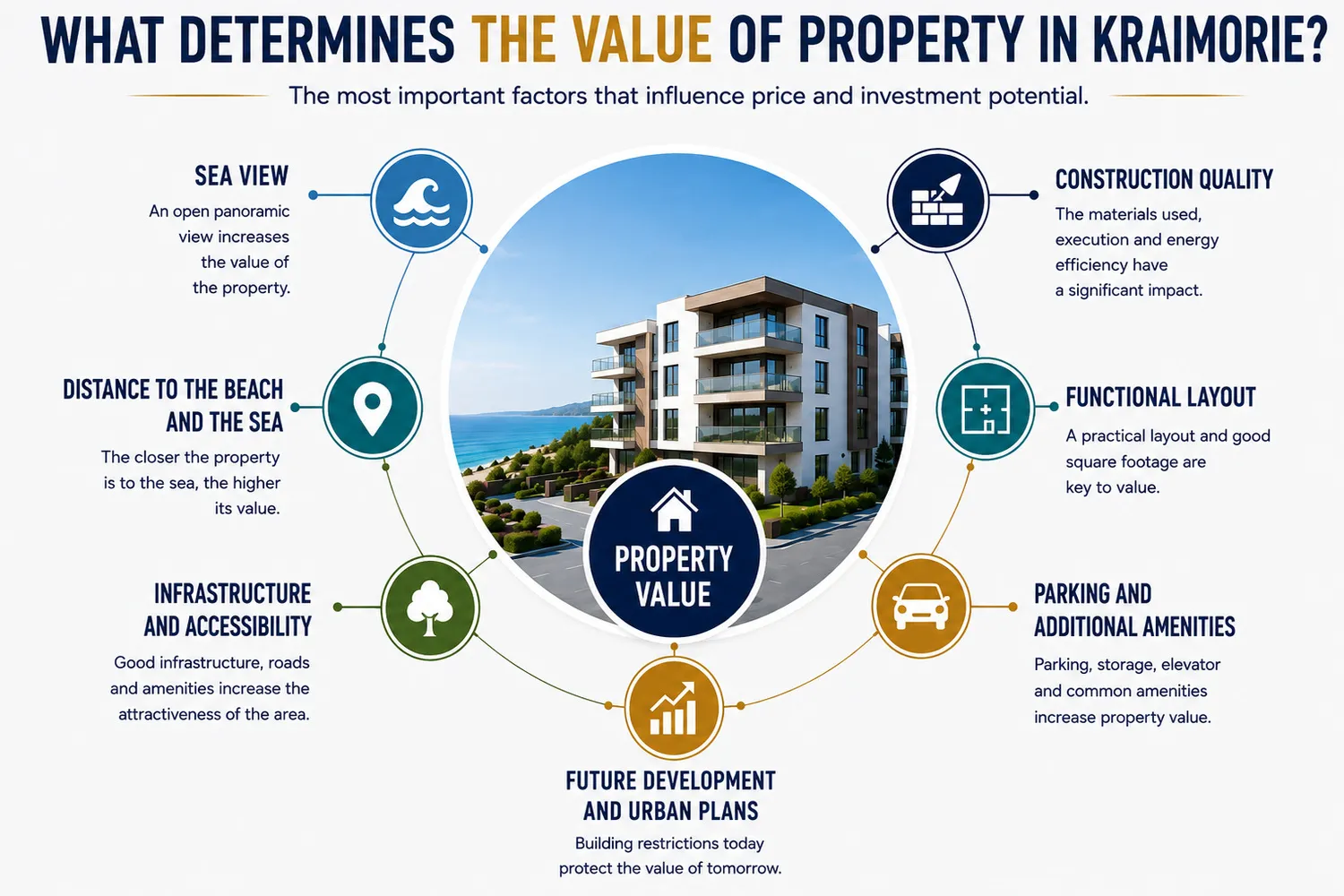
Location remains one of the most important factors in property investment, but in Kraimorie it requires a more detailed analysis than simply identifying the neighbourhood. A sea view is usually a strong advantage, but the investor should also determine whether that view is likely to remain open if future construction takes place nearby.
Proximity to the beach is valuable when it is combined with convenient access. A distance of only a few hundred metres may look insignificant on a map, but steep terrain, a lack of pavement or an inconvenient walking route can change the way a buyer or tourist perceives the property.
Parking also has increasing investment value. For larger apartments and houses, the possibility of having two parking spaces can influence the final purchase decision, particularly for families or buyers who plan to live in the property throughout the year.
For apartments, other important factors include floor level, orientation, practical layout, terrace size, lift access, storage and maintenance charges. For houses, additional considerations include the size and shape of the plot, garden orientation, the possibility of adding a swimming pool, road access, infrastructure and the level of privacy.
Ultimately, the property with the highest investment value is not necessarily the largest or the most expensive. More often, it is the one that offers the best balance between location, functionality, quality and price for its target buyer.
A cheap price per square metre can become an expensive investment
Price per square metre is a useful benchmark, but it can be misleading when used as the main investment criterion. A cheaper apartment may be more difficult to rent, may have no parking, may suffer from an inefficient layout or may be located in an area with weaker infrastructure.
The opposite can also be true. A more expensive apartment with an attractive open sea view, practical layout, good parking and proven demand may ultimately offer stronger liquidity and better long-term value.
The same principle applies to houses. More floor area does not automatically mean greater investment efficiency. In many cases, a compact and intelligently designed house with a reasonable garden can be easier to sell or rent than an oversized property that is expensive to maintain.
A professional assessment should therefore begin with the future buyer or tenant. Who is likely to want this property? Why would they choose it? What realistic alternatives will they have on the market? The answers to these questions are often more important than the headline price per square metre.
How should a property investment be evaluated before purchase?
Before buying, the property should be analysed not simply as a product but as a financial asset. This means calculating not only the purchase price but the total amount of capital required before the property starts generating income or becomes ready for resale.
In addition to the purchase price, the investor may need to include transaction costs, local taxes, agency fees, finishing works, furnishing, appliances, parking, maintenance charges and financing costs. With an off-plan property, the time required until completion should also form part of the calculation.
A sound assessment should answer at least three questions: how much capital will be invested in total, what realistic net income the property can produce and how easily it could be sold if necessary.
For income-producing property, conservative assumptions are usually preferable. If an apartment appears attractive only when occupancy is almost full and rental prices remain at peak levels throughout the year, the risk is high. If the numbers still work during a weaker season or with several vacant months, the investment is considerably more resilient.
Do not compare properties only by price per square metre
Price per square metre is one of the easiest figures to compare, but it rarely tells the whole story. Two apartments can have the same size and similar asking prices, yet one may have a sea view, a parking space and a large terrace while the other has none of those advantages.
The difference in their investment potential can therefore be much greater than the difference in their initial purchase price.
The same applies to houses. A lower price per square metre can simply reflect excessive built area, an inefficient layout or a weaker location. From a resale perspective, a smaller but more functional home may be considerably more liquid.
For this reason, price per square metre should be used as a reference point, but never as the only basis for an investment decision.
Liquidity matters as much as yield
Investors often concentrate on projected returns while underestimating liquidity. Liquidity describes how easily a property can be sold at a reasonable market price, and it becomes especially important with expensive or highly specialised homes.
A large apartment, an unusual house or a high-priced property may be attractive, but if only a small number of buyers can realistically afford or want it, the sale may take considerably longer.
Properties that meet the needs of a wider group of buyers are generally easier to resell. In the apartment market, functional one- and two-bedroom homes, practical family apartments, secure parking and strong micro-locations can all contribute to better liquidity.
This matters greatly for investors with a medium- or long-term horizon. A theoretical capital gain is not equally valuable if realising it requires a long marketing period and a substantial discount from the asking price.
Future development around the property can change its value
In a developing area, it is important to analyse not only what exists today but also how the surroundings could change over the next several years.
An empty plot in front of an apartment may eventually be developed. A quiet road could become a main access route to a new residential complex. On the other hand, new infrastructure, roads and services can substantially improve the attractiveness and value of nearby property.
For this reason, investors should investigate the planning status of neighbouring plots, permitted development parameters and available information about future construction. This is especially important for properties whose value depends heavily on a sea view or an open sense of space.There is a crucial difference between a view that exists today and a view that is effectively protected from future obstruction. The two should never be treated as the same thing.
Infrastructure has a direct impact on investment value
Even an excellent property cannot fully compensate for weak surrounding infrastructure. For year-round living, road access, streets, lighting, sewerage, electricity supply, parking, connections to major roads and access to everyday services all matter.
This is particularly relevant in newly developing parts of Kraimorie, where residential construction can sometimes progress more quickly than the infrastructure required to support it.
From an investment perspective, this creates both risk and opportunity. A property purchased before infrastructure improvements are completed may increase in value once those improvements are delivered. However, if the necessary works are significantly delayed, demand and liquidity may remain weaker than expected for a longer period.
The main risks of residential property investment in Kraimorie
No property is completely risk-free. The objective is to identify the risks before purchasing and reflect them in the price the investor is prepared to pay.
For off-plan property, the main concerns are construction deadlines, quality of execution, project financing and delays before the building can be officially commissioned and occupied.
For completed property, construction uncertainty is lower, but other problems may exist, including high maintenance charges, poor building management, insufficient parking or weaker-than-expected demand.
With short-term rentals, seasonality is the main risk. A particularly strong summer should not automatically be treated as representative of the whole year. With long-term rentals, the investor should consider vacancy periods, changes in tenant demand and maintenance costs between tenancies.
For houses, the risk is often connected with the higher overall value of the investment and the smaller pool of potential buyers. On top of these property-specific risks come broader market factors such as changes in credit conditions, economic uncertainty, growth in new supply and changes in household purchasing power.
The most common mistakes property investors make
One of the most common mistakes is buying primarily because a property appears cheap. A low price does not automatically mean an opportunity. It may reflect a weaker location, insufficient infrastructure, an inefficient floor plan or limited resale potential.
Another frequent mistake is relying on overly optimistic rental projections. Investment calculations should be based on realistic average rental rates and sensible occupancy assumptions rather than the highest advertised rate during peak season.
Additional costs are also often underestimated. Furniture, repairs, property-management fees, commissions and periodic replacement of equipment can significantly reduce net returns.
With off-plan property, investors may focus only on potential appreciation while ignoring the time until completion. With houses, the equivalent mistake is often trying to maximise floor area instead of functionality. This can increase construction and maintenance costs while making the property harder to sell later.
Which property is best for each investment strategy?
There is no single property type that is right for every investor. The most suitable choice depends on the objective of the investment.
For someone looking primarily for capital appreciation and willing to accept greater uncertainty, entering a high-quality project at an early stage can offer attractive potential. For an investor prioritising immediate cash flow and greater predictability, a completed apartment in a strong location may be the more logical choice.
For short-term holiday rentals, micro-location, walking distance to the beach, parking, views and furnishing quality are likely to be among the most important factors. For long-term rentals, functionality, accessibility, reasonable running costs and suitability for year-round living become more important.
Townhouses can suit investors looking for a balance between private outdoor space, final purchase price and a relatively broad target audience. Detached houses and villas are more suitable for the higher-value segment, where buyers are looking for land, privacy, gardens and lifestyle rather than simply the number of square metres inside the building.
When does a property investment make the most sense?
The most resilient investments rarely depend on a single source of return. If an apartment must increase in value by 20% for the purchase to make financial sense, the risk is relatively high. If, however, the investment can be justified through a combination of reasonable rental income, long-term value retention and the possibility of resale, it has a much stronger foundation.
The same principle applies to houses. If the property’s value is supported by genuine scarcity, such as a strong location, private land, quality construction and limited supply, its investment profile is stronger than that of a home whose premium price comes mainly from expensive interior finishes.
Furniture depreciates over time. Land, location and a well-designed property have a much longer economic life.
Short-term or long-term investment?
Residential real estate is generally better suited to medium- and long-term investment strategies. Short-term resale can be successful when the investor selects the right project at the right stage of a rising market, but it is more dependent on current market conditions.
Over five, ten or more years, the investor can potentially benefit not only from changes in property value but also from accumulated rental income and the broader development of the area.
For Kraimorie, this long-term perspective is one of the main reasons the district deserves attention. If its transformation into a more functional year-round coastal residential area of Burgas continues, demand for well-positioned properties may increasingly come from a broader group of buyers rather than only from seasonal tourism.
That does not mean every property will appreciate equally. On the contrary, as the market develops, the difference between high-quality assets and compromised properties may become even more visible. Strong micro-locations, parking, architecture, reasonable maintenance costs and functional design are therefore likely to play an increasingly important role.
Conclusion: the best investment is not necessarily the cheapest property
Kraimorie offers several different opportunities for property investors, ranging from off-plan apartments and completed rental properties to townhouses, detached houses and villas. Each of these assets comes with a different balance of rental yield, potential capital appreciation, liquidity and risk.
There is no universal answer as to whether it is better to buy off-plan or completed property, or whether an apartment is preferable to a house. The correct choice depends on the objective of the investment, the amount of capital available, the investment horizon and the investor’s tolerance for risk.
What matters most is that the decision should not be based only on expectations of future price growth or on an apparently low price per square metre. Real investment value comes from the combination of location, construction quality, functionality, time to income, total capital invested and the ease with which the property can eventually be rented or sold.
A carefully selected property in Kraimorie can offer an interesting combination of coastal real estate and residential investment close to a major city. This dual role distinguishes the area from many purely seasonal resort markets and creates different opportunities depending on the investor’s strategy.
Ultimately, a strong investment should still make sense under normal market conditions, not only during a record tourist season, a period of rapidly rising property prices or an unusually favourable opportunity for quick resale. When a property is well located, functional, well built and acquired at a sensible price, the investor has considerably more options for generating current income, preserving capital over the long term and eventually realising a profitable exit.